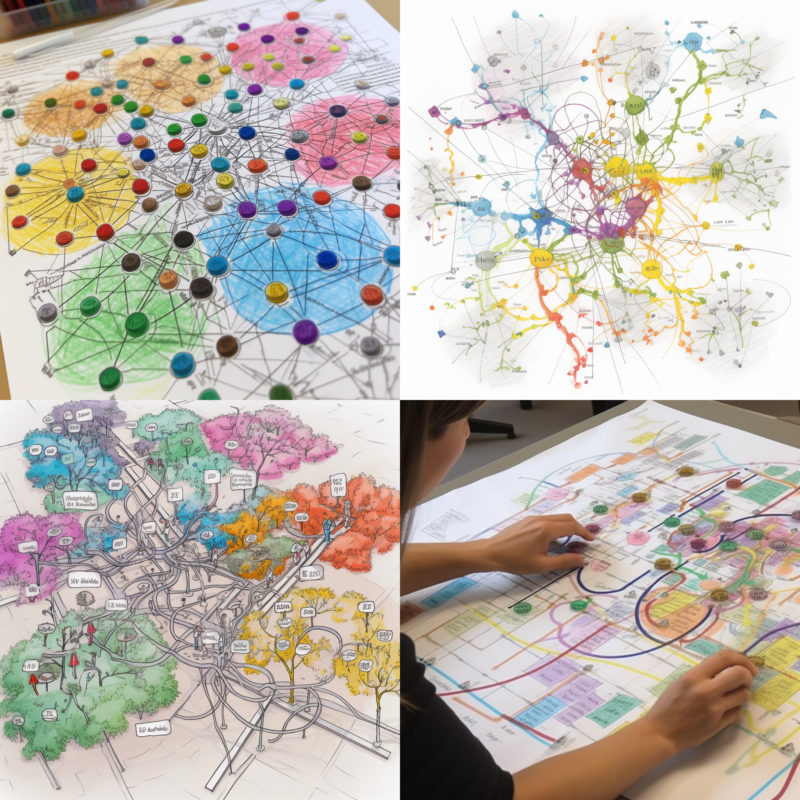
Networks and complexity – a feedback loop

ZZ45F743FE

Just posted a review of Grouped on the Brilliant Noise blog. It is such a fascinating book, I think I could happily blog about it all week – in fact I may do…

One of the insights which tickled me, was the idea that increasing amounts of information and complexity could make us more reliant on social networks than ever before.

When we are uncertain about what to do, we turn to others to help us make a decision…. In a world of exponentially increasing information, decisions will be harder because our capacity for memory will remain the same. With exponentially increasing information, and limited capacity for memory, we will increasingly turn to others to help us decide.

We are becoming hyper-connected: we are using online networks to stay in touch with more people. These may be more people who are on the periphery for us, but we are connected all the same.

These networks, along with the wider increase in available content that the web brings, means there is more noise out there. More choices, and more complexity in trying to make decisions.

Accord to Paul Adams, author of Grouped, this means that we will rely on our social networks to help us make those decisions. We do this a lot of the time anyway, but with more choices and more complexity we will do it more so.

Which means the complexity which is revealed and created by our living in bigger networks, will in turn make us more reliant on those networks.

I’m going for a lie down in a dark, un-networked room now. But it is an interesting phenomenon, isn’t it?

Slow-mo social: Friction and frictionless sharing

ZZ467BBDF9

Interesting train of thought set in motion by an excellent blog post from Chris Thorpe.

He makes a case for “frictionless sharing” (stuff you read or see or listen to being shared automatically with your social network) as promoted by Facebook, being “noisy and for robots” while “declarative frictionfull sharing” (deciding to share things and putting a little effort into doing so) as being meaningful. Continue reading

This blog

ZZ7226309F

One slightly unexpected but pleasant surprise for me in the launch of the new Brilliant Noise was how energising I found it to have the new website and its blog go live.

Developed with craft and care by Endless and Brighton’s patron-saint-of-Wordpress David Lockie, the site looks and feels right. But it’s what’s to come that I found excited – I realised that I had a real imperative to start blogging more often, as part of helping it come to life. Continue reading

Week notes and some not-so-weak links

So here are some links and notes from my week

Weeknotes

It’s a few weeks to go until the new website goes live for Brilliant Noise (see a preview in the brand treatment from Endless), and I’m thinking one of the things I may well do is have weeknotes. It’s a simple idea which I cam across via Robin Sloan. Companies like Berg share some thoughts about their week every Friday. Continue reading

Media needs its architects

At the Edinburgh International TV Festival last month, Google executive chairman, Eric Schmidt, told delegates to “ignore Lord Sugar” and bring more engineers, more science, into the TV industry. This was essential, he argued, if they wanted to break the pattern of UK innovating things that would be scaled up into global businesses elsewhere.

NewImage Continue reading

Discovery engines

?

Image: Getting discovery engines to work is an uphill struggle…

Discovery engines are, as Farhad Manjoo for Fastcompany has it…

the word du jour in tech

Or…

the search engine’s smart-ass cousin that tries to answer vague queries (like “funny video”–one of the top searches on YouTube).

…the discovery engine remains a mythical beast. Today’s personalization tools are built on several faulty premises. There’s still too much presuming that we want a steady diet of what we just consumed. Just because you clicked on one post of Sarah Palin reinterpreting history doesn’t mean you want to hear all she has to say.

Another is that we’re interested in everything that our friends are. (I like my friends despite their inexplicable devotion to Mad Men.) Continue reading